1
Entry diagnostics
We define your level and build a personal learning route.
Learn to test web and mobile products, work with APIs, write clear bug reports, and build a portfolio for your first offer.
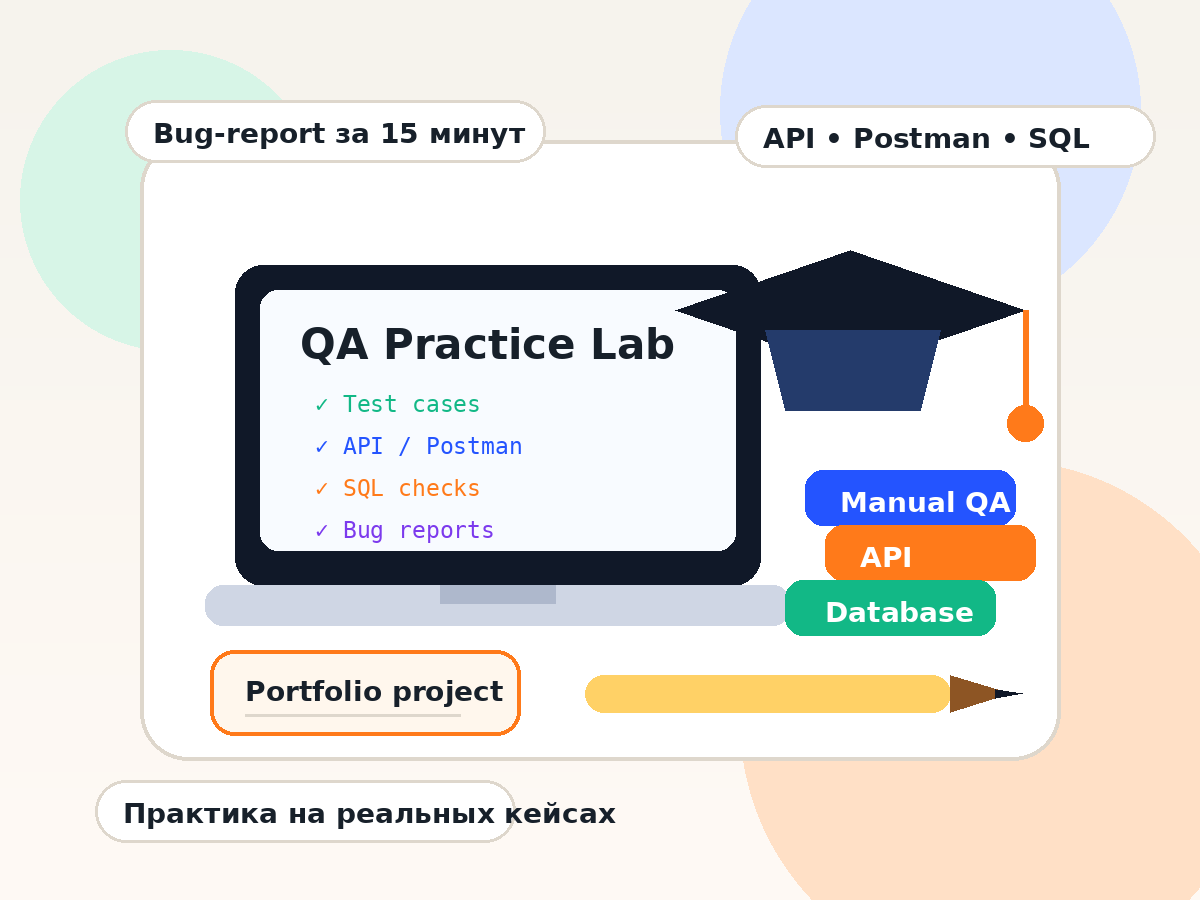
The presentation is rebuilt from scratch: less template feel, clearer structure, and more real tasks.
We define your level and build a personal learning route.
Checklists, test cases, bug reports, API requests, and mistake reviews.
CV, profile, portfolio, and interview preparation.
A clear route from first QA terms to confidently presenting the final project.

Learn testing types, the development lifecycle, and the QA role in a team.
Test interfaces, forms, mobile scenarios, and user flows.
Work with Postman, JSON, HTTP statuses, SQL, and integrations.
Understand automation basics and choose your next stack: Python, Java, or JS.
Prepare your portfolio and practice interviews with a mentor.
QA Core · API · SQL · Automation · Career
You will learn what a QA Engineer does, how QA differs from QC, how SDLC and STLC work, and where testing fits into a real product team.
Outcome: you understand the QA profession, basic processes and the value of testing for product quality.
You will learn how to design checks before execution, create checklists, test cases, test scenarios and documentation that is clear for the whole team.
Outcome: you create a QA documentation package for your portfolio and learn how to choose the right checks for each task.
You will test user interfaces, forms, personal accounts, responsive pages, mobile scenarios, cross-browser behavior and common frontend defects.
Outcome: you can test a website or app independently and clearly describe defects.
You will understand how frontend communicates with backend, what HTTP/HTTPS, REST API, JSON, status codes, headers, parameters and authorization mean.
Outcome: you can test API without a user interface and find backend-level issues.
You will learn SQL queries required for QA work: finding records, comparing UI data with database values and checking business logic.
Outcome: you can verify data independently and communicate more confidently with backend developers.
You will learn how to describe defects so developers can quickly understand and reproduce them, and how bug lifecycle works in a team.
Outcome: you write professional bug reports and manage defects according to team workflow.
You will understand why automation is needed, how automated tests are structured and where manual testing connects with automation and development processes.
Outcome: you understand the technical side of QA and are ready to join a real development team.
You will combine everything into a final project: documentation, UI testing, API checks, SQL queries, bug reports and a presentation for your portfolio.
Outcome: you have a set of work samples for employers and a clear strategy for entering the market.
Flexible formats for solo learners and teams.
Self-paced learning
Mentor and projects
For companies
Leave your contacts and we will suggest the right format and send the course program.
Yes, the course starts with fundamentals and gradually moves into practical tasks.
Yes, there is a dedicated module for Postman, HTTP, JSON, and integration checks.
Pages are prepared in Russian, Kazakh, and English.
Leave your contacts and we will suggest the right format and send the course program.